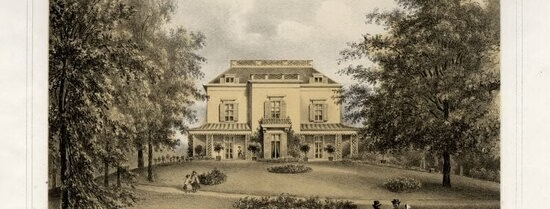
On Thursday 23 April, Risbo presented its research report on Zeist’s history of slavery during a public council meeting of the municipality of Zeist. This historical study highlights how Zeist was linked to the colonial system. Risbo also examined how Zeist’s current residents view this past, and what role they believe the municipality should play in addressing it.
The research shows that there were clear links between some of Zeist’s prominent residents, administrators and economic networks and the colonial history of slavery. The wealth of this social elite in Zeist was closely linked to trade in the colonies. Some of them were also actively involved in the remote ownership and management of plantations in Suriname and Berbice. Historical sources explicitly refer to how this management also extended to the enslaved people who worked on the plantations. The money earned from this flowed back into the local economy and was invested, for example, in property. Parts of Zeist’s current landscape, such as Hoog Beek & Royen and Arendsburg, are tangible reminders of this history.
The Municipality of Zeist, then and now
The municipality, as an administrative body, was not directly involved. This is linked to Zeist’s historical development: as a relatively small and recently established municipality, it had limited influence and resources and focused primarily on local matters. Risbo not only conducted historical research, but also asked the current residents of the municipality of Zeist for their views on how to deal with the colonial past, and what role they see the municipality playing in this. The residents of Zeist appear to be divided: both on the lingering effects of the colonial and slavery past and on the role of the local council. Young people and residents with roots in the former Dutch colonies, in particular, are more likely to experience these lingering effects and are more positive about the need for attention and recognition.
During the meeting on 23 April, researcher and project leader Youri Seidler outlined the key findings and recommendations. Mayor Langenacker then gave an initial administrative response: “This research highlights that this past is also part of Zeist. It helps us to better understand how this history is connected to our society today.”
Recommendations
A key recommendation from Risbo concerns ‘translating’ the research findings into more public-friendly forms of communication, so that this part of history can be shared more easily with the residents of Zeist. In addition, the researchers advocate enriching existing information in public spaces with context and interpretation, in order to strengthen awareness and recognition of the colonial and slavery past. The municipality of Zeist will follow this up by presenting a public-friendly version of the research report in June. It will also set up an education working group to focus on developing materials and activities to ensure that this part of local history is permanently incorporated into the community.

Youri Seidler MA
Project lead and researcher
- Email address
- seidler@risbo.eur.nl
