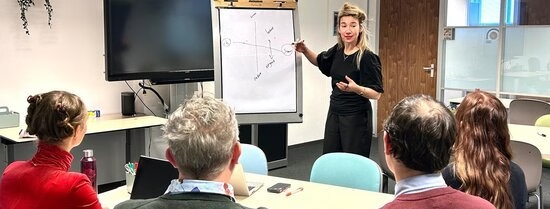
How do you teach novice teachers to deal with a noisy classroom? How do you practice coaching a team or dealing with resistance during educational innovation or organizational change? Teachers and professionals who train themselves in these kinds of challenges at Risbo do so not only by talking or listening. They practice concrete situations. With each other, and with training actors. Afke Weltevrede is a researcher, trainer and training actor at Risbo and she talks about how working with training actors helps to learn.
Servant acting
It's not ‘a little fun acting,’” Afke stresses. "Training acting requires craftsmanship. You don't play a pretty scene, but connect to what the participant needs to learn. That means servant acting, in service of the learning goals."
Like Risbo colleagues Jana, Sascha and Tom, Afke took specialized training to fulfill this role professionally. She also regularly performs as a classically trained actor in theater. But these two types of acting are very different, she says: "Training acting requires a different kind of focus. You are constantly switching gears: you play believable behavior AND you observe, so you can give constructive feedback afterwards."
Learning by doing
Training actors are widely used at Risbo: during MicroLabs about group dynamics and storytelling, but also in leadership programs such as the Educational Leadership Course. "In one case, you help a teacher-in-training convey his or her story more powerfully. In the other case, a leader is practicing how to engage in conversation with a team experiencing resistance."
It's always about behavioral change, says Afke. "What do you do, what effect does it have, and what could you do differently? You learn that not only by thinking about it, but especially by experiencing it. In a safe setting. You can experiment, reflect, and immediately see the effect of different behavior."
A mirror and a smile
Afke often sees participants come in with healthy anxiety. "That makes sense - it's exciting to try something new, especially if it involves yourself. But that also means you learn. And fortunately, there is also a lot of laughter. It's playful, it's fun. We create an atmosphere where people feel safe AND have fun at the same time."
Archetypes
What does Afke herself enjoy most about playing? "I really enjoy seeing the powerful effect of small adjustments in your approach. People often think their situation is unique, but at the core there are many universal types: the unmotivated student, the dominant colleague, the employee who steps into the victim role. As a training actor, you may also be a bit of the ‘joker’ in these kind of situations - you poke around, you challenge, but always with a learning objective in mind."
Broadly applicable
The use of training actors fits in with Risbo's mission: facilitating good education and sustainable behavioral change, in education and beyond. Think of communication exercises in pedagogy (such as parent talks), medical sciences (doctor-patient contact), and courses in which interview and conversation skills are central. But also in occasional activities where the use of an actor contributes to perception and understanding: at a conference or event or in business training or coaching, for example.
"Working with people requires communication skills. And you learn those mainly by doing," says Afke. "We offer participants the chance to practice, to reflect, and thus to grow. That's where our strength lies."
I always really enjoy working with a training actor. It is a good way to learn, which I use myself with my own students.
Lot attended the MicroLab “How to manage group dynamics in your classroom,” in which Afke acted as a training actor. "In fact, I find that it comes across much better than when I tell it alone or when the students discuss something among themselves. During the MicroLab, we re-enacted a situation with a passive-aggressive student who did not take me seriously as a teacher. It was really fun to do it again and get the feedback from Afke and the group. I also tried a different approach to notice the difference. Playing along in a colleague's “case” was also instructive: this way you experience it from the other side, as a student. The nice thing about the MicroLab is that you are with a small group, among equals, which is less exciting than in a large group."
Lot Tiebosch
Lecturer and PhD candidate at ESHPM
 Afke Weltevrede
Trainingsacteur en onderzoeker
Email address Jana de Wit
Onderwijsadviseur en trainingsacteur
Email address
