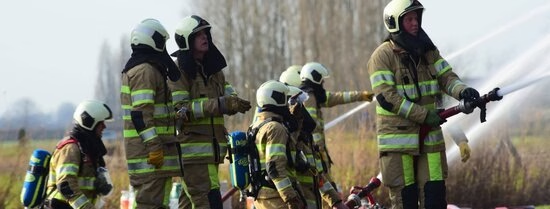
Firefighting is a profession, and it’s one you pursue with passion. The same applies to designing and delivering high-quality education: a completely different profession. The Dutch Institute for Public Safety (NIPV) wanted to make significant progress in the professional development of its lecturers and reached out to Risbo.
Professionalism and teaching
The NIPV is the national knowledge institute for public safety. The institute works on behalf of all 25 safety regions in the Netherlands and deals with a range of topics: from the fire fighting service and crisis management to civil protection. Training courses for fire fighter officers, training for the GHOR, specialist training for divers and gas suit wearers: the NIPV develops and delivers them all.

The people who teach at the NIPV are always dedicated to their profession. Fire service specialists who may have been fighting a major fire just a week earlier are standing in front of a class as instructors the very next day. Ciska Baris, team manager for operational fire service training, affectionately calls them ‘workaholics’: “I mean that as a compliment; they are people with a deep passion for the fire service.” And that was precisely what presented a challenge, she explains. “The focus was more on the subject matter, but to be a good educational institution, you need to pay just as much attention to teaching: How do you structure a course? What does it mean to design effective teaching? That aspect got sidelined.”
The gap between subject matter and teaching
At the NIPV, subject matter experts – known as trainer-advisers – work closely with educationalists. In theory, a powerful combination. In practice, however, these were often two worlds that did not always mesh well. “The trainer-advisor wants to move quickly; they want to get things done. The educationalist is often inclined to focus on thoroughness and ensuring that all the details are correct.” What was missing was a common language and a greater understanding of each other’s perspectives. Ciska had previously worked at the Police Academy, where she had been involved in a similar professionalisation process. As a result, she had a good idea of what was needed and got in touch with Risbo.
The UTQ programme: more than just a certificate
Together with Risbo, the NIPV launched a UTQ programme (University Teaching Qualification) for an initial group of eight permanent trainer advisers. This is not a standard training course, but a tailor made programme adapted to the NIPV’s unique teaching practices: it therefore includes live fire drills and simulations at training venues.
The process is still ongoing, but the effects are already noticeable, for example in the collaboration between trainer-advisers and educational experts. “Whereas they used to clash more easily, they now understand each other better,” says Ciska. For instance, she has noticed that trainer-advisers are using educational terms that they were previously unfamiliar with. "I can hear them saying to each other: 'Yes, but what are the learning objectives then?' I didn’t hear that phrase before." The educational experts have noticed it too. "They say they find it easier to connect with the students. At first, it sometimes felt like playing the nagging parent, as if you were constantly putting the brakes on. That has changed."
Risbo developed a specific University Teaching Qualification programme for the NIPV, closely tailored to the organisation’s teaching and training practices and the didactic level of its subject experts. Over a period of 11 months, a group of eight NIPV colleagues attended five different modules/training days covering topics such as lesson design, group dynamics and assessment. In June 2026, they will obtain their University Teaching Qualification, which is recognised by Dutch universities.

Brian Smits is a trainer-advisor at the NIPV and one of the participants in Risbo’s BKO programme. He immediately saw it as a great opportunity to refresh his knowledge. Some things weren’t necessarily new, but it was good to go over them again. His days at school – in his case, the pedagogical-didactic qualification and the fire service instructor training – were, after all, some 10–15 years ago. “I enjoyed learning about today’s standards and found it very insightful right from the start. I soon realised: wow, there is quite some room for improvement if we look at the way we do things internally.”
Eye-opener
What sticks with participants most is the way the course is structured as a whole. “They discovered that you don’t start with individual lessons, but with assessment. That you build from the top down. That might sound obvious, but for people who have always worked from the subject content itself, it was a significant shift,” says Ciska.“We often set aside an hour to create a test,” says Brian, “but I now realise that I might need to allow an hour per question – to ensure it really aligns with the learning objectives we’ve set. That was quite an eye-opener, making me think, ‘hang on a minute, this isn’t something you can just knock out in a flash’.”
What also really appealed to Brian was Risbo’s teaching style. In particular, because it was very interactive, with lots of different teaching methods, which were clearly explained at the end of the lesson. “It wasn’t very traditional, which I liked, and thanks to that clear summary at the end, I was able to put what I’d learnt into practice straight away.”

Drawing techniques
He also touched on Risbo’s drawing techniques: “I have a very graphic mindset myself and prefer to use as little text as possible. The task of answering a question on a blank sheet of paper by means of a drawing, for example, immediately struck a chord with me. I really like that approach; it instantly gives the question a refreshingly different angle.” What’s more, this approach suits our target group well. We like to make things visual. For example, if we need to put out a fire, we often draw a diagram: a visual representation of the situation, so that it’s clear to everyone exactly who is doing what.”
An unexpected spin-off
One side effect that Ciska hadn’t anticipated was that training instructors have also started to look at the simulations used by the NIPV in fire service training courses in a different light. These are often large-scale and impressive, with a large number of participants re-enacting full-scale incidents on military training grounds, including real fires. But from an educational perspective, there is still room for improvement in this area too.
During the programme, one of the trainer advisers asked aloud: what actually makes a good simulation? When is a scenario simple, and when is it complex? And how do you link that to the course’s learning objectives? “The programme got him thinking about things we’d always taken for granted,” says Ciska. “Now he really wants to do something with that.”
The future
The programme is still in its final stages, but the direction is clear. Ciska ultimately wants all permanent trainer advisers and deans at the NIPV to complete the BKO programme. “As a national training institute for all safety regions, I believe it is appropriate that our permanent staff have the same qualifications as lecturers at colleges and universities. Not just for the certificate, but because they really learn from it.”
Text: Hanna van Impelen-Emmering
- More information
Does this sound familiar?
Does your organisation also employ subject experts who teach or deliver training courses? And do you find that the transition from subject knowledge to effective teaching doesn’t happen automatically? If so, the NIPV’s experience may well resonate with you.
Risbo supports organisations outside the mainstream education sector in the professional development of teachers, instructors and trainers: with programmes tailored to your practical needs, your staff and your objectives.
- Related education
