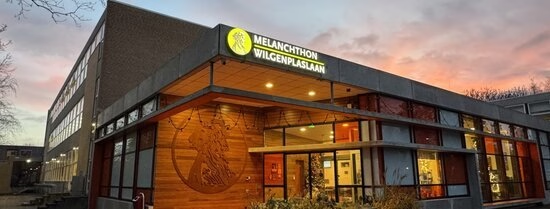
Vincent Wolsheimer, branch manager of Melanchthon Wilgenplaslaan in Rotterdam, leans back as he thinks back to the beginning of his collaboration with Risbo. That dates back years, when Wolsheimer was still working at a vocational school in The Hague. Joost Maarschalkerweerd, then a trainer at Bazalt, gave a training course that was very well received. ‘What really appealed to me was that the theoretical basis of what was being taught was combined with its direct application in the training itself. This allows you to experience for yourself what is meant. That's what I call hands-on support.’
After moving to Melanchthon Wilgenplaslaan in 2018, Wolsheimer re-established contact with Joost, who was now working at Risbo. Over the past four years, this has resulted in training courses and meetings on topics such as differentiation, didactic working methods and storytelling.
Champions League level in a complex context
Melanchthon Wilgenplaslaan is what Wolsheimer calls ‘a mixed vocational school that, in terms of “multi-problematics”, is really the city of Rotterdam in miniature.’ The school is located in Schiebroek Zuid, an economically disadvantaged part of the city. What does such a context demand of teachers? Wolsheimer is clear: "Well, it demands Champions League people. You can become a professional footballer because you enjoy it and kick a ball around at FC Emmen. But if you really want to get the most out of it, you want to go to Real Madrid. That's the level of teachers that we need here. The context in which we work requires more than just knowledge transfer. Here, you always have to be on your toes, always be able to deliver your best, as if you actually want to win that cup with the big ears every year. That demands a lot from you as a teacher – and that teacher needs a well-stocked backpack of didactical skills to do that."
Professionalisation and customisation
Over the past eight years, the school has been working hard to improve itself. ‘We have an extremely motivated team that is committed to the pupils. However, we are moving from a very informal culture to an increasingly professional one. That said, we do not want to completely abandon the informal culture, because it also plays an important role in the personal dynamics and in the desire to work for each other.’
In 2019-2020, the school wrote its own school plan for the first time, after years of school group-wide plans. ‘The team was intensively involved through carousel sessions, where everyone could give input on various pillars of the management plan,’ says Wolsheimer. One of the major themes was and is customisation, which is reflected, among other things, in the flexible timetable that Melanchthon works with. The example that Wolsheimer often uses: "We regularly see that pupils no longer score so well on their Dutch language skills, but they do score well on English. For example, someone shows that they can get a pass mark with two hours a week. Yet, because we decided so, they all have to sit through four English lessons of 50 minutes each. Why? No idea, but they do disrupt the lesson. So that was one of the reasons for differentiating."
Differentiation: from theory to practice
The transition from theory to practice in the field of differentiation proved to be quite a challenge. According to Wolsheimer, there are two reasons for this: ‘Due to the complex target group, teachers usually need a lot of time for class management and teaching the basics. As a result, there is not always time to address requests for help, i.e. for more in-depth or extended instruction.’ The second reason has to do with expectations. ‘What are the expectations at the start of the lesson? When are you satisfied with an assignment? Does the pupil also know what they need to achieve at the end of that assignment? What we were already doing well was setting a goal. But what we could still improve was to make that goal very small: if you are going to do this assignment, I want to be able to see that this, this, this and this has been done.’
And that's where Risbo came back into the picture. Wolsheimer remembers the session well. We were all put to work drawing in the auditorium. "We were allowed to draw our dream beach house. Then we suddenly had to assess that beach house: if you had three windows, you got two points. One window, one point. Zero windows, no points. Then everyone was like: evaluate, what are you talking about? You didn't say there had to be windows!"
The session was an eye-opener for many and, according to Wolsheimer, exemplary of Risbo's way of working: "It's never just a case of: you're going to learn something new from me. You really experience what it's been like up to now, and also what it will or can do for you.’
Anchoring change
As director and manager, Wolsheimer is convinced of two things: speaking the same language and the power of repetition. He therefore tries to attend as many of the various training sessions as possible. ‘That way, I know what has happened and can refer to it when I talk to a teacher.’ Important insights are also regularly cited during the “press conference” – the weekly central moment when the school management reviews the week. During one such central moment, for example, a teacher presented a new case containing all the activating teaching methods and materials they had practised with Joost. In addition, Wolsheimer tries to regularly involve Risbo, and Joost in particular, in programmes or training courses that contribute to the professional development of the teachers. ‘Joost has become a familiar face, an anchor point.’
The language of learning
Another important aspect of education at Melanchthon is skills training, which provides ample opportunity for practice and guidance for pupils in their personal growth. They use a list of 23 skills, which are incorporated into the teachers' learning objectives. Risbo has provided support in linking these skills to “the language of learning”. This means that teachers had to “translate” the skills relevant to their subject, i.e. describe very specifically what they expect from pupils in that area. Wolsheimer explains: "If a teacher says, “You just have to learn your homework”, it is not actually clear what exactly is expected. How should the pupil do that and how do you help them to approach it in a subject-specific way? This also means, for example, that a teacher must clearly convey that there is a difference between learning words, learning concepts and learning situations. That is a completely different skill and you have to make pupils aware of that."
Inclusive and appropriate education
Inclusive education will be an important topic on the agenda for the next ten years. This is quite a challenge: on the one hand, there is a need to strengthen basic support, while on the other hand, Wolsheimer is keen to maintain balance and protect his team: ‘We absolutely must move with the times and provide further training in line with the needs of society, but we must also ensure that we, as a school and in the classroom, do not have the solution to all the problems in the world.’ He would also like to make progress in the area of appropriate education, for example by working together smartly within the school group.
When asked for advice for other school principals, Wolsheimer's response is quick: ‘I have already brought Joost to the attention of my school group. I am very satisfied and would advise everyone to involve him, especially if they have ambitions to strengthen the didactic framework and competences of their teaching team.’
Copy: Hanna van Impelen-Emmering
